Why willpower doesn't always work
At the start of my career, as a fresh grad, I thought I had a networking problem, on account of me being super shy. I just couldn’t for the life of me bring up the courage to mingle and somehow always ended up hiding away next to the food (you can’t talk with your mouth full). So I did what most of us do with a problem like that: I tried to get better at it. I read the tips. I practised my opening line. I told myself to just put on my big-girl pants and walk over. None of it stuck, and not for a lack of trying.
Six months into my career, I was lucky enough to be coached as part of a young professional program. I brought in my personal struggles with networking, and after a brief exchange the coach asked asked what I was actually afraid of in that moment, just before giving in to an excuse why I couldn’t walk over to a merrily-chatting group. The words just rolled out: "What if I won't belong, again?"
I'd always just assumed "I'm shy" was a fixed part of my personality, and that networking was something that I needed to “willpower” my way through. But that conversation taught me something invaluable: instead of putting in more and more effort, I could reduce my internal resistance to networking. Now that I found the fear sitting underneath, I could question if that was the rule I wanted to live by. I got a choice.
A pyramid for where you're actually stuck
There's a simple model that explains this, called the Logical Levels. It was first sketched out by anthropologist Gregory Bateson and later developed further by Robert Dilts. It describes the different levels at which we can experience change. It’s a pyramid with six layers, wide at the bottom and narrowing as you go up:
Context / environment – where you are, who you're with
Behaviour – what you actually do and say
Competencies – your skills, knowledge, capability
Values and beliefs – what matters to you, what you hold to be true
Identity – who you understand yourself to be
Purpose / mission – the bigger picture you see yourself as part of
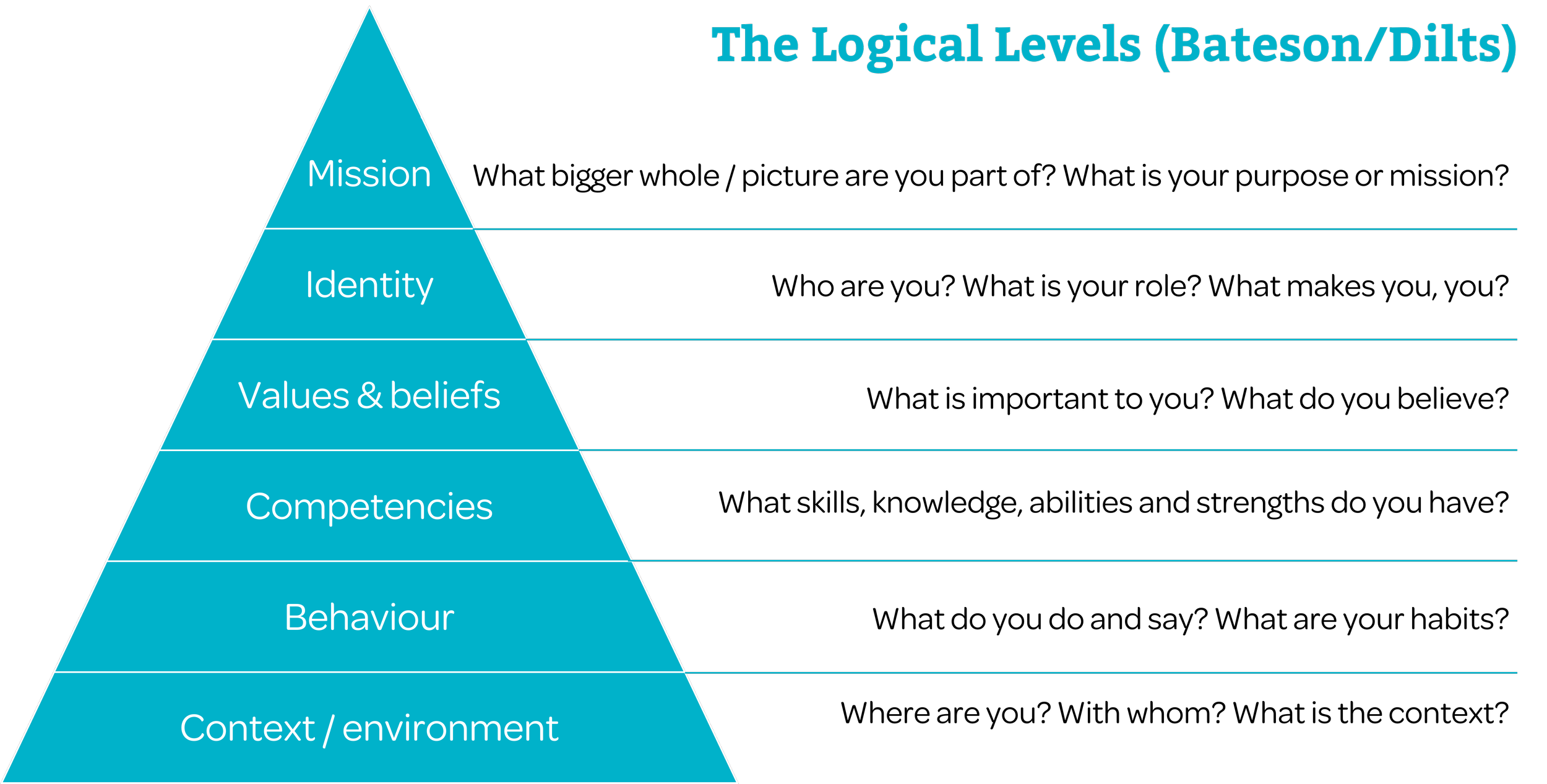
The bottom three are the concrete, visible stuff. It's where most advice lives, and where most of us instinctively put our energy when something isn't working: read the book, learn the technique, do the thing more often. Sometimes that's exactly the right call. If you genuinely haven't learned to run a meeting yet, learning to run a meeting will help.
But the top three are where a lot of the real weight sits, and they're much sneakier, more hidden. You may not know you’re carrying a belief like: "If I'm not 100% certain, I shouldn't say anything". All you do know is that you hesitate or over-prepare before speaking up, the behaviour that follows from the belief.
Why the effort doesn't land
As you can see from my own example: no matter how badly you want to exhibit behaviour B (mingling with people), if your belief is dictating something else (I won’t belong), you will stay stuck in behaviour A (hiding out at the food table). That’s because the top of your pyramid is more core, and it will outrank whatever you're doing at the bottom. You can build the skill, learn the framework, rehearse the talk, and still not act any differently, because a belief sitting a few layers up has already decided the outcome.
A few limiting beliefs that I keep hearing:
"If I'm not experienced enough yet, I shouldn't speak up."
"Asking for help means I'm not capable."
"My work should speak for itself (so I shouldn't have to promote it)."
They sound reasonable, even sensible, which is exactly why they're so hard to spot. They don't feel like beliefs. They feel like facts about how the world works, or about who you are. And that’s if you’re even aware you’re operating by rules like this in the first place!
What this means practically
Think of one thing you keep trying to fix at the skills-and-effort level, that hasn't actually shifted no matter how much willpower you muster. Maybe it's speaking up in meetings, maybe it's putting your hand up for something bigger, maybe it's something else entirely. You've probably already tried the obvious fixes: a course, a script, a "just do it" pep talk to yourself in the mirror.
Now ask, gently and out of genuine curiosity rather than self-judgement: is there a belief underneath this that I've never actually questioned? What am I assuming is true here, about the situation or about myself?
Just noticing your “invisible rules” it is a great place to start. And if you want to dig deeper, I’m always happy to connect and answer any questions.
Yours in mind-bending,
Kelly