How to grow your self-awareness & confidence
Five practical exercises to get you started
Below, you will find five practical exercises that have helped me grow my self-awareness & confidence most effectively. They are not the only exercises I have applied, but they are the ones that have made the biggest impact with the least effort. The time in the right-hand corner of every card indicates how long each exercise approximately runs for.
The purpose of the flash cards is to give you something tangible to work with condensed on one page. Please be aware that the material can be enriched / expanded to suit your needs. I have included additional considerations, tips and examples for each of the exercises on this page. Please do reach out if you would like further guidance or to share which exercise worked best for you.
Contents
1. Identify your limiting beliefs


2. Transform your limiting beliefs


3. Treat yourself with kindness



“Semantic offenses”
We tend to criticise ourselves much more harshly than we would another in the same position, or our brain jumps to exaggerated conclusions that make things look worse than they are. Here is a list of common “semantic offenses” that can make us feel bad unnecessarily if unnoticed.
-
Explanation: Assuming you know what someone else is thinking or feeling without evidence.
Statement: "He doesn’t like me."
Challenge: "How do you know that?"
-
Explanation: Making a value judgment without identifying the source of the judgment.
Statement: "It’s bad to be late."
Challenge: "According to whom? How do you know that?"
-
Explanation: Equating two things as if they have the same meaning, often without justification.
Statement: "She didn’t reply to my email, so she doesn’t care about me."
Challenge: "How does not replying mean she doesn’t care?"
-
Explanation: Implying something is true within the structure of a sentence.
Statement: "If I fail this test, my career is over."
Challenge: "What makes you think you will fail? Why would failing end your career?"
-
Explanation: Using words like "always," "never," or "everyone," which overgeneralize situations.
Statement: "Nobody listens to me."
Challenge: "Nobody? Can you think of someone who has listened to you?"
-
Explanation: Using words like "must," "should," or "have to," implying obligations or rules.
Statement: "I must work harder to succeed."
Challenge: "What would happen if you didn’t? Why must you?"
These “semantic offenses” are just a few of the 11 patterns of the Meta-Model in Neuro-Linguistic Programming. If you want to learn more about that, patience! More is to come!
4. Celebrate being you & your life

-
Here are a few suggestions for a daily mood booster if you need some inspiration! The aim is to pick something that fits in your schedule and is effective for you, so make sure to try out a few to land on a good one!
Practice gratitude: Write down three things you're grateful for each day.
Morning affirmations: Say positive statements about yourself aloud to start the day.
Take a short walk: Spend 10-15 minutes outdoors to clear your mind and refresh.
Smile in the mirror: Look at yourself and smile—it can trick your brain into feeling happier.
Compliment someone: Brightening someone else’s day can uplift your own.
Stretch or do light Exercise: Move your body to release tension and feel energized.
Practice deep breathing: Try a 5-minute breathing exercise to calm your mind.
Tidy your space: Organizing a small area can give a quick sense of accomplishment.
Listen to uplifting music: Play songs that make you feel happy and powerful.
Write down small wins: Acknowledge small achievements from your day.
Do a random act of kindness: Helping others can boost your self-esteem.
Learn something new: Spend 5-10 minutes reading or watching something educational.
Visualize success: Picture yourself succeeding in a current goal or task.
Dance it out: Move to your favorite upbeat music to release endorphins.
Stand tall: Practice good posture to feel more confident and assertive.
Drink your favourite tea or smoothie: Staying hydrated can improve energy and mood.
Declutter your mind: Write down your worries and let them go.
Practice a skill: Spend 10 minutes improving something you enjoy or want to master.
Laugh: Watch a funny video or recall a humorous moment to boost your mood.
Repeat a constructive belief: Remind yourself, “I can handle anything that comes my way.”
5. Thoughts are stories
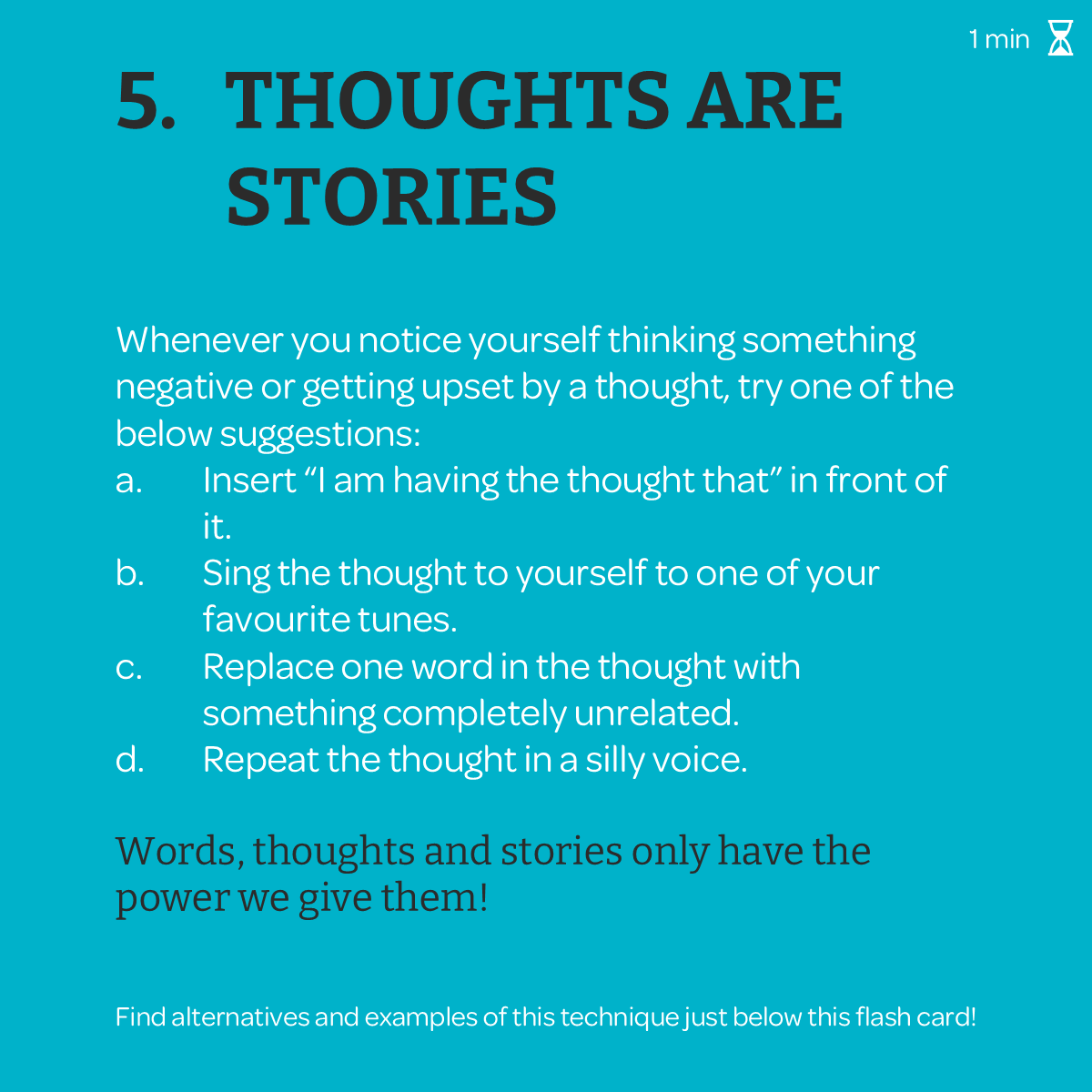
A common technique in Acceptance and Commitment Therapy (ACT), the following are examples to “disarm” the upsetting thought: “I am such an idiot!”
Replace with: “I am having the thought that I am such an idiot.”
Sing “I am such an idiot” to the tune of “Jingle Bells”.
Replace “idiot” with toothbrush to be: “I am such a toothbrush.”
Repeat the thought in the voice of Miss Piggy.
Call out this personal story. Tell yourself “Ah, the “I’m an idiot” story”.
Thank your mind for the thought and move on to something else. “Thanks, Mind!”.
The purpose of the exercise is to recognise that thoughts are just words, and words by themselves do not hold any power over you. It helps to acknowledge that some thoughts we have are not helpful and may not be true or important.
If I have piqued your interest in ACT, more to follow on that later!